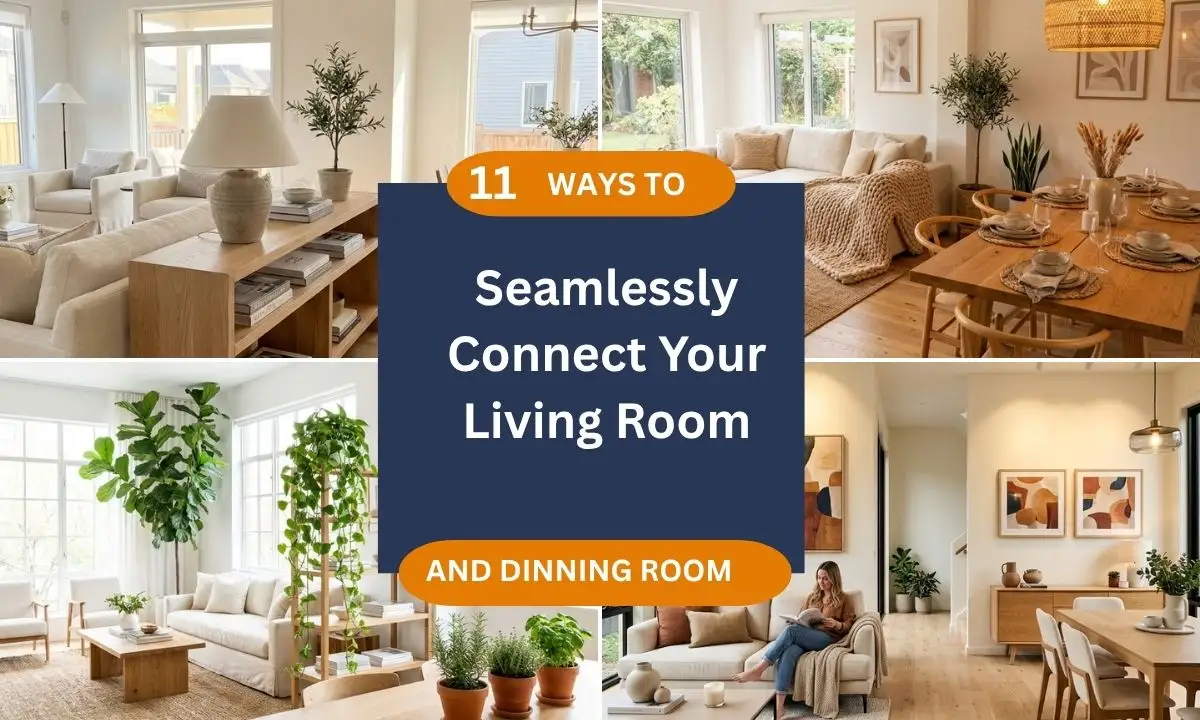
13 Ways to Seamlessly Connect Your Living Room and Dining Room
Introduction
Your living room and dining room deserve to feel like one beautiful, flowing space. Learning how to seamlessly connect the living room and dining room doesn’t require a full renovation or a big budget. It just requires the right ideas.
I’ve noticed that even small, intentional changes, such as a shared color palette, consistent flooring, or coordinated lighting, can completely transform how an open-plan layout feels to everyone who walks in.
Many homes have these two areas sitting side by side but feeling disconnected. The furniture doesn’t relate. The colors compete. The space feels unfinished. That feeling is more common than you think, and it’s completely fixable. In my experience, most people are just a few simple decisions away from a home that looks intentionally designed and visually cohesive throughout.
This article gives you 13 Seamlessly Connect Your Living Room and Dining Room ideas clear, practical, and visually inspiring ideas to bring both spaces together. Whether your home is large or small, rented or owned, modern or traditional, these ideas work. Save this post, pick one idea that excites you, and start there. The transformation you’ve been imagining is closer than you think.
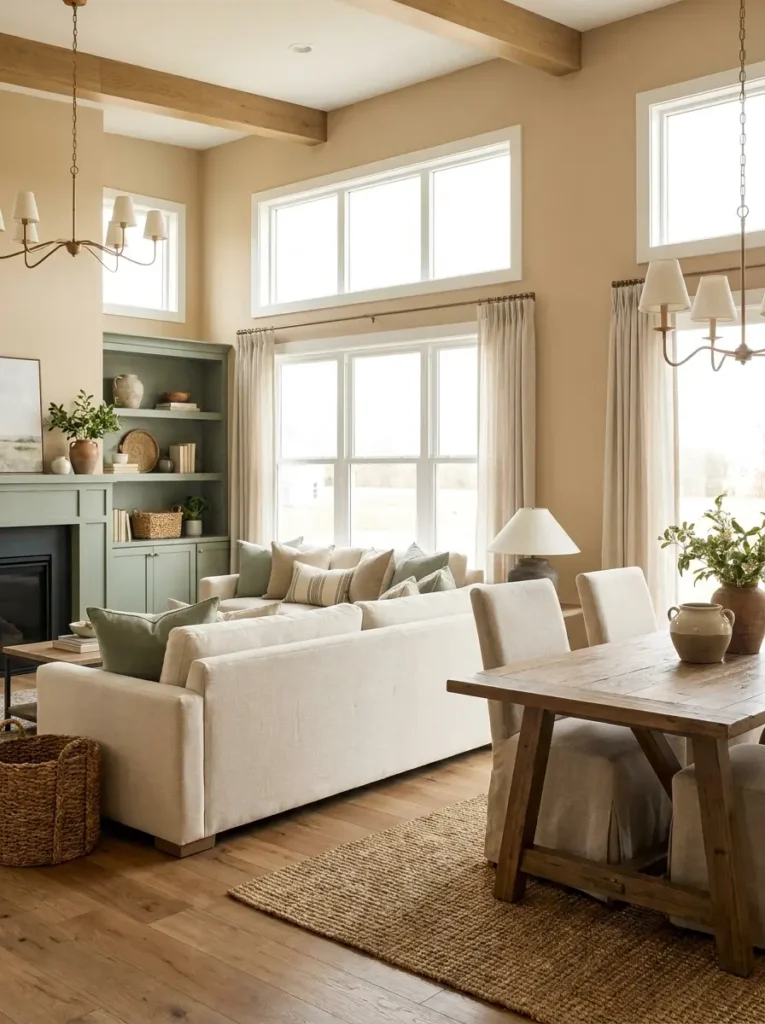
Matching Color Palette
- Shared wall color makes two separate zones feel like one designed space
- Even small color echoes, like matching cushion tones to chair fabric, build visual harmony
- A neutral base palette works across different furniture styles easily
- Repeating one accent color in both zones tricks the eye into seeing more space
- You don’t need a renovation, just color consistency across both areas
Color is the fastest way to unite two spaces in one home. When both your living and dining areas share the same palette, the eye moves smoothly without interruption. You don’t need identical furniture or matching sets.
Just repeat one or two tones in cushions, curtains, or wall paint. That simple repetition creates instant visual flow. It signals that the space was designed with intention. Even a single shared accent color makes a noticeable difference throughout.
That’s why many designers recommend starting with color before any other decision. It sets the foundation everything else builds on. When your sofa cushions echo your dining chair fabric, the result feels polished and pulled together.
I’ve noticed this single step transforms how spacious a combined layout feels to anyone walking in. Pick two or three tones you love. Use them consistently across both zones. The payoff is a home that looks thoughtfully designed from every angle.
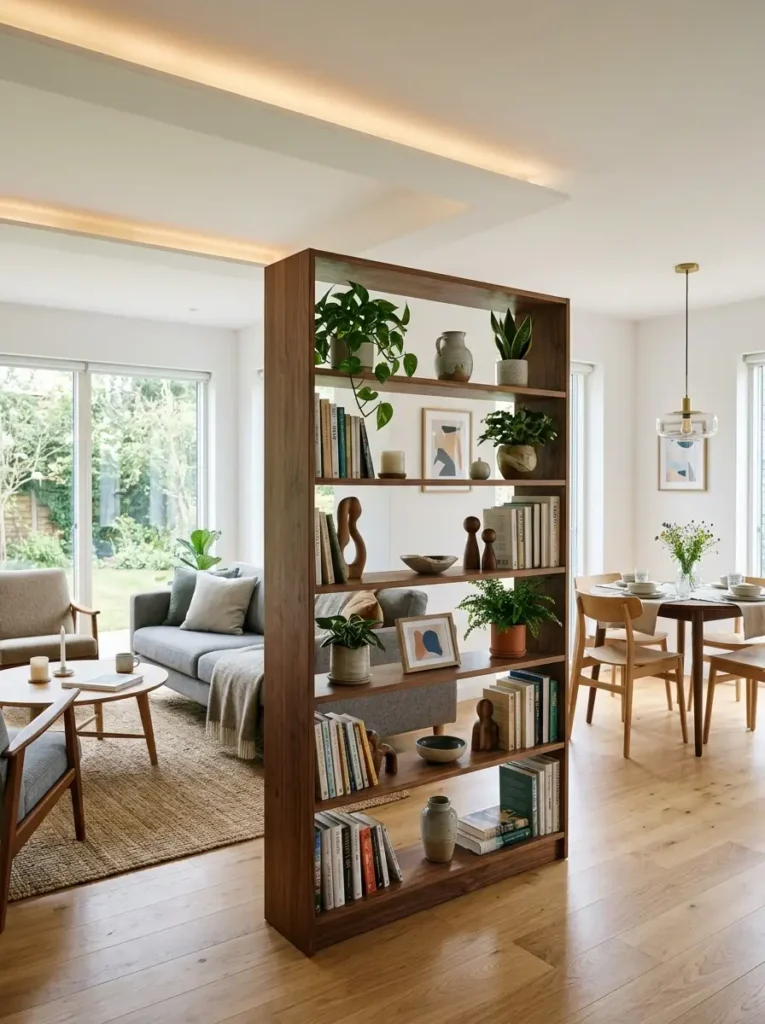
Open Shelving Divider
- Open shelves divide space without blocking light or making rooms feel smaller
- Style both sides of the shelf to face each zone separately
- Adds storage, display space, and a design feature all in one piece
- Plants, books, and ceramics add warmth and personality to both areas
- Works especially well in apartments where building walls is not an option
A shelving unit can do what a solid wall never could, which is divide without closing off. Open shelves create a visual boundary that feels intentional, not restrictive. Light passes through freely. Both sides stay bright and connected.
Unlike heavy room dividers, this approach keeps the living and dining areas in conversation with each other. Each zone gets its own identity while still feeling part of the whole. It’s a smart, flexible solution that works beautifully in most homes.
I’ve seen this work brilliantly in smaller homes where every inch matters. A well-styled open shelf becomes the focal point of the entire room. Style one side toward the sofa area and the other toward the dining table.
Mix practical items with decorative ones, including books, small plants, candles, and ceramics. Vary heights and textures for visual interest. The result is a functional, Pinterest-worthy feature that makes the whole open-plan layout feel considered, creative, and beautifully put together.
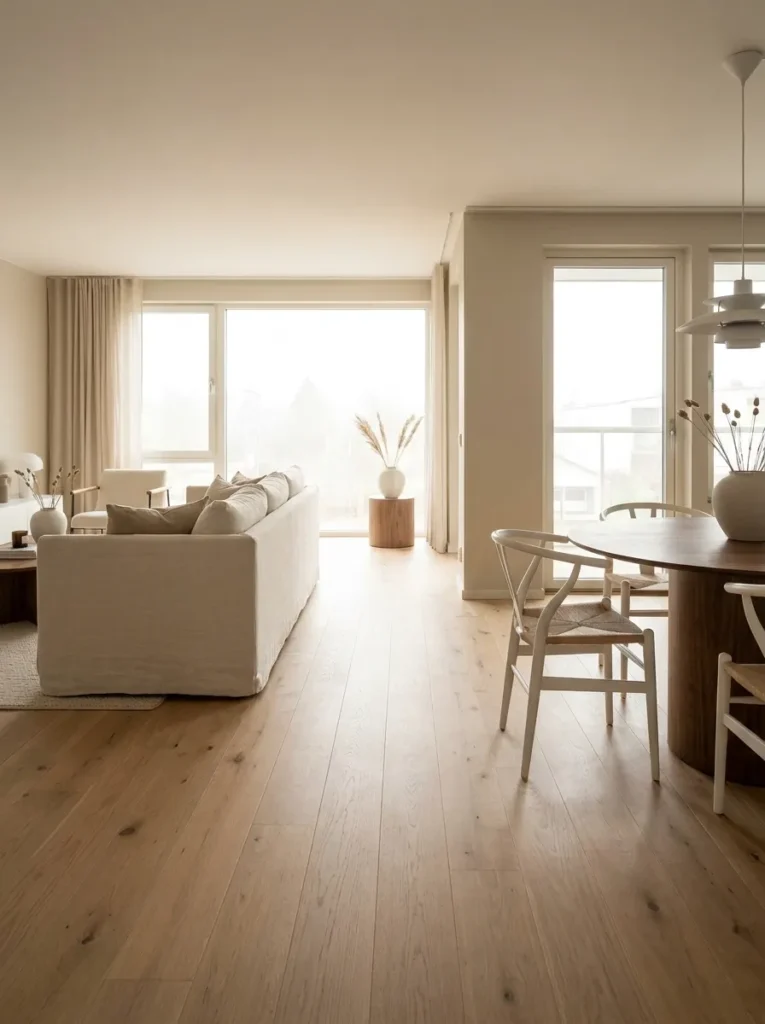
Continuous Flooring
- Same flooring across both zones is one of the strongest visual unifiers available
- Removes visual breaks that make a space feel chopped or disconnected
- Continuous flooring makes the full area feel larger and more intentional
- Works with wood, tile, or LVP, and the key is no transition strip between zones
- One of the first things designers recommend when planning any open-plan layout
Few design choices are as quietly powerful as continuous flooring throughout a home. When the same material runs uninterrupted from your sofa to your dining table, both areas immediately read as one cohesive space.
There’s no visual break, no awkward threshold, and no moment where the eye gets confused. It’s one of those foundational decisions that does enormous design work without drawing attention to itself. And that effortless invisibility is exactly what makes it so effective in real homes.
Homeowners who renovate with open-plan living often say continuous flooring was their single best decision. It simplifies everything that follows, including rug placement, furniture arrangement, and lighting choices.
When the floor flows, the whole room follows naturally. Whether you choose light oak planks, large-format tiles, or polished concrete, keeping it consistent helps to seamlessly connect the living room and dining room without any extra effort. The space looks intentional, modern, and designed, all from one smart foundational choice made early.
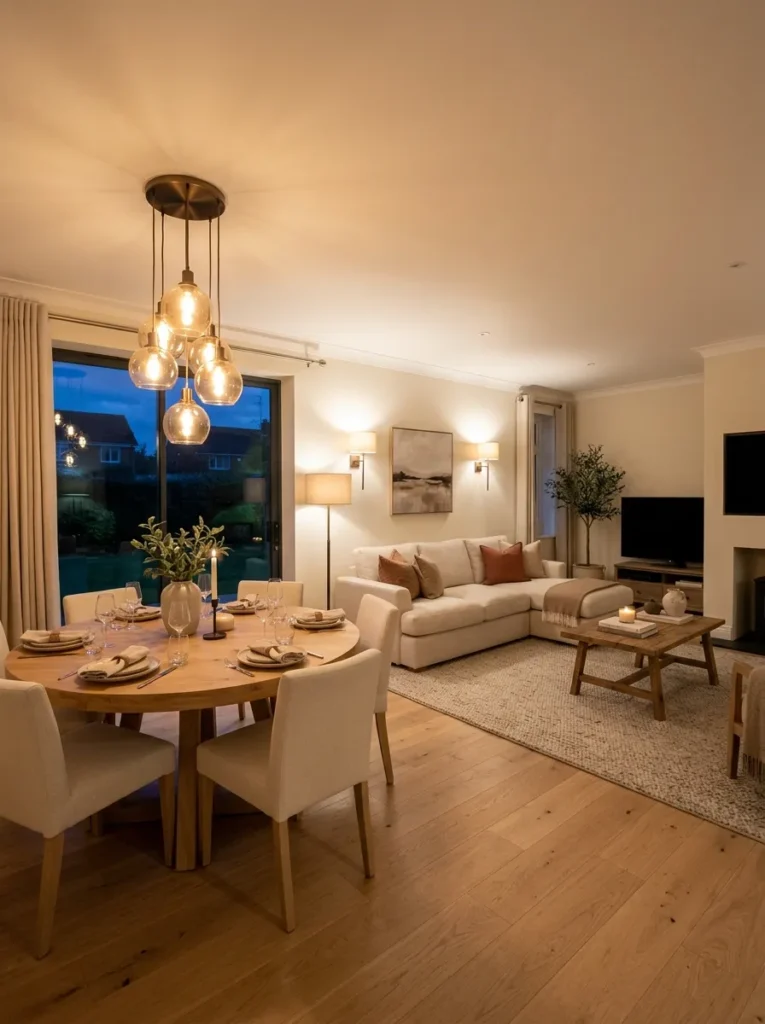
Unified Lighting Scheme
- Matching light fixtures across both zones creates instant visual cohesion
- Warm-toned bulbs in both areas make the entire space feel inviting and unified
- A statement pendant over the dining table anchors that zone beautifully
- Floor lamps and sconces in the living area balance the overhead dining light
- Lighting temperature matters as much as fixture style, so keep both zones consistent
Lighting is the one design element that changes everything after dark. When both your living and dining areas share the same warm tone and fixture style, the entire space feels intentionally designed.
Mismatched lighting, such as cool white in one zone and warm yellow in another, creates visual tension you might not immediately identify but always feel. Coordinated lighting removes that tension completely. It wraps both areas in the same glow, making the whole open-plan layout feel calm, cohesive, and beautifully considered.
The fixture style matters just as much as the bulb temperature. Choose pendants, sconces, or floor lamps that share a common material or finish, such as brushed brass, matte black, or warm wood tones.
You don’t need identical pieces. Just related ones. That visual relationship between fixtures quietly signals that both zones belong together. I’ve noticed that updating lighting alone, without changing any furniture, can completely transform how connected and polished a combined living and dining space feels.
Coordinated Furniture Style
- Matching furniture legs, materials, or finishes creates strong visual continuity
- You don’t need a matching set, just pieces that share one common element
- Similar upholstery tones across sofa and dining chairs tie both zones together
- Furniture style consistency makes an open-plan layout look purposefully designed
- A mix of textures within the same style family keeps the space feeling rich, not flat
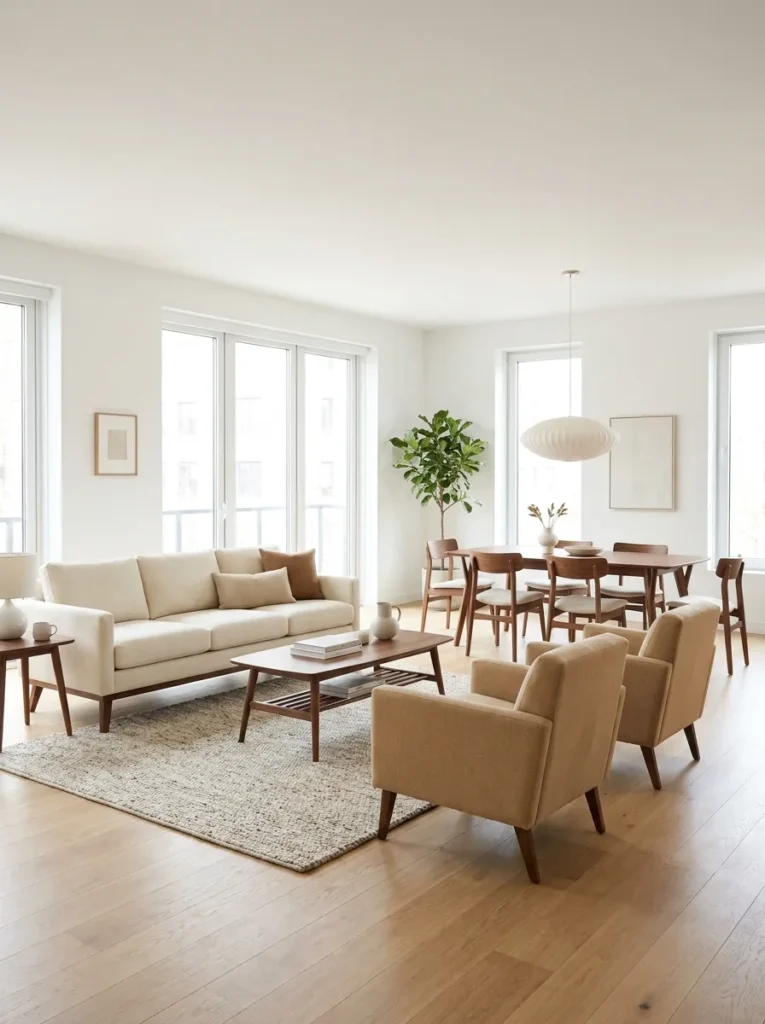
Your furniture tells the story of your space before anything else does. When the living and dining areas share a consistent style, even loosely, the whole room feels designed rather than assembled.
You don’t need a matching set from the same collection. You just need pieces that share something, such as a leg finish, an upholstery tone, or a general aesthetic direction. That small common thread running through both zones creates a visual rhythm that makes the entire layout feel pulled together naturally.
Mid-century modern, Scandinavian, and transitional styles all work beautifully in open-plan homes because their clean lines translate well across different furniture types. A walnut dining table paired with a walnut-legged sofa, for example, creates instant cohesion without feeling too matchy. That’s why many designers recommend choosing one style direction first, then selecting all pieces within that family. It removes guesswork and ensures every item you bring into the space contributes to a unified, intentional look across both areas.
Defined Area Rugs
- Area rugs define each zone clearly without using walls or dividers
- The living room rug should be large enough to anchor all seating furniture
- Dining room rug must extend beyond chair legs even when chairs are pulled out
- Rugs in complementary colors or patterns tie both zones together visually
- Texture and material of the rug adds warmth and depth to the overall space
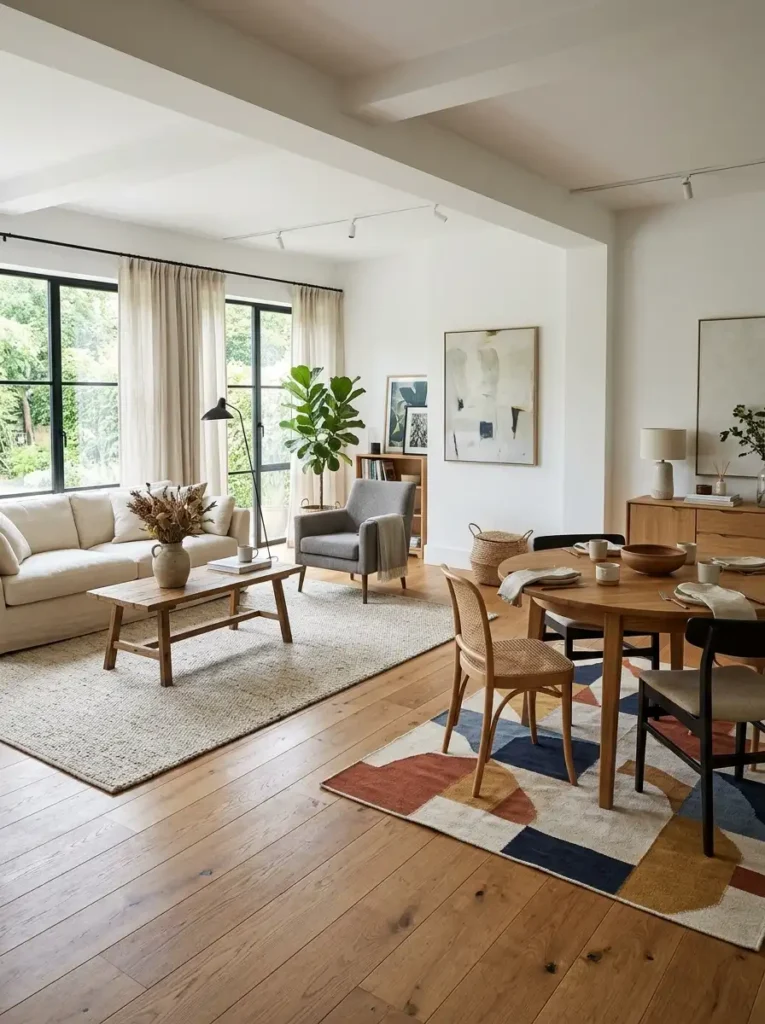
A well-placed rug does something no paint or furniture arrangement can fully achieve, and that is defining a space within a space. In an open-plan layout, rugs act as invisible walls that give each zone its own identity.
The living area feels grounded and cozy. The dining area feels purposeful and complete. And because both rugs remain visible from the same viewpoint, their relationship to each other matters. Choose complementary colors or patterns that share at least one common tone for best results.
Sizing is the detail most people get wrong on the first attempt. The living room rug must be large enough to sit under all key furniture legs. The dining rug must extend well beyond the chair legs, even when pulled out for seating. I’ve noticed that undersized rugs are one of the most common mistakes in open-plan homes. Getting the size right instantly elevates the entire space. It makes both zones feel finished, intentional, and professionally designed throughout.
Shared Accent Wall
- One accent wall shared across both zones visually locks the two areas together
- A bold wall color draws the eye across the full length of the open-plan space
- Works with paint, wallpaper, shiplap, or stone cladding for varied texture effects
- The accent wall becomes an anchor point that both zones naturally reference
- Choose a color that complements furniture in both areas for best visual balance
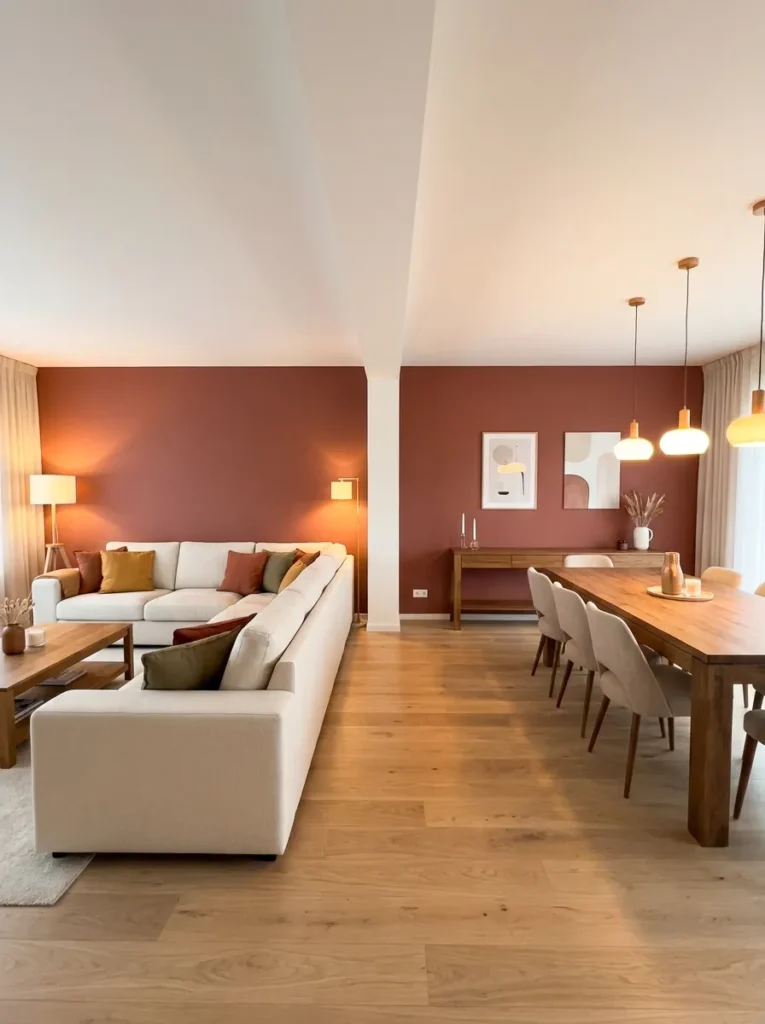
One uninterrupted accent wall can do more for an open-plan layout than almost any other single change. When the same bold color or textured surface runs behind both the living and dining areas, it creates a powerful visual spine for the entire space.
The eye follows that wall from one end of the room to the other. Both zones feel anchored to the same design decision. It removes the fragmented feeling that open-plan spaces sometimes develop when each area is decorated independently.
The material you choose adds another layer of personality to the space. Deep paint colors like terracotta, forest green, or navy make a bold statement. Textured options like limewash, shiplap, or stone cladding add warmth and depth that flat paint simply cannot replicate. Keep the rest of the walls neutral so the accent surface gets full attention. I’ve seen this approach completely transform a disconnected open-plan layout into a space that feels cohesive, dramatic, and intentionally designed from one end to the other.
Consistent Window Treatments
- Matching curtains or blinds across both zones create immediate visual continuity
- Floor-to-ceiling curtains make ceilings feel higher and spaces feel more expansive
- Consistent fabric tone softens the overall look and adds warmth throughout
- Linen, cotton, and sheer fabrics work well across both living and dining areas
- Same hardware finish, such as curtain rods and rings, adds a polished coordinated detail
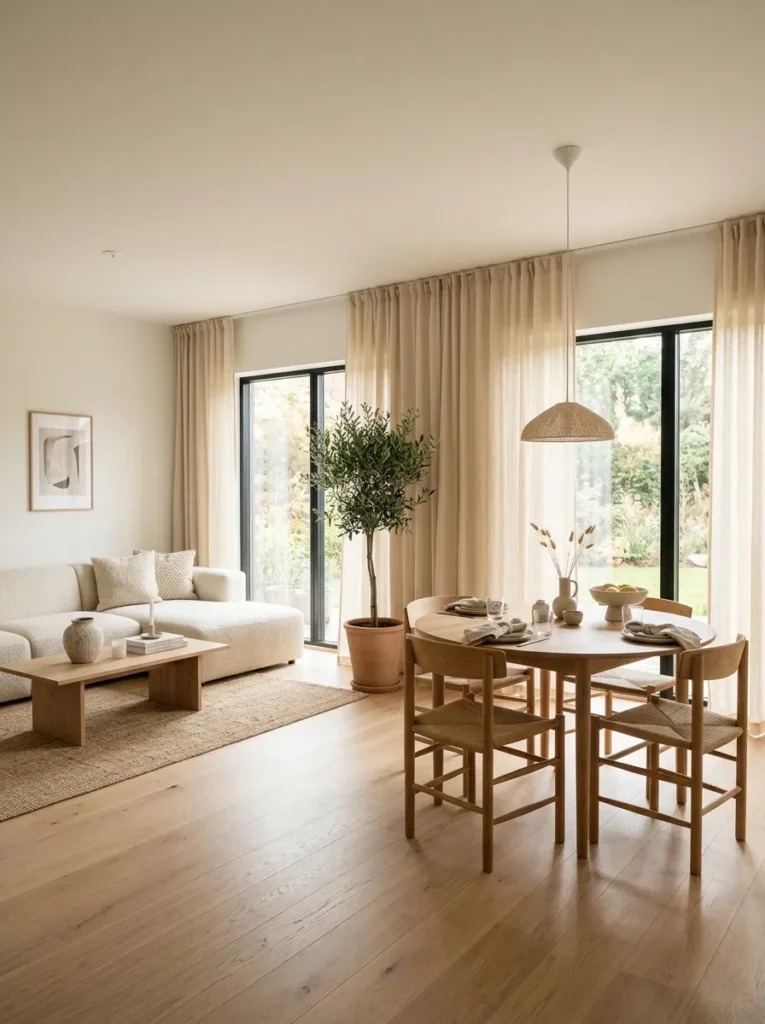
Window treatments are one of the most overlooked unifying tools in an open-plan home. When both the living and dining areas share the same curtain fabric, color, and hanging style, the entire space instantly feels more cohesive.
The windows become a repeated visual element that ties everything together quietly. Most people focus on furniture and color first, but matching your window treatments across both zones delivers a surprisingly strong and immediate improvement to the overall feel of the space.
Floor-to-ceiling curtains work particularly well in combined living and dining layouts. They draw the eye upward, making the ceiling feel higher and the room feel larger. Choose a fabric that complements your wall color and furniture tone, such as warm ivory linen, soft white cotton, or light grey sheers.
That’s why many designers recommend treating all windows in an open-plan area as one continuous design decision rather than handling each window independently. The unified result speaks for itself.
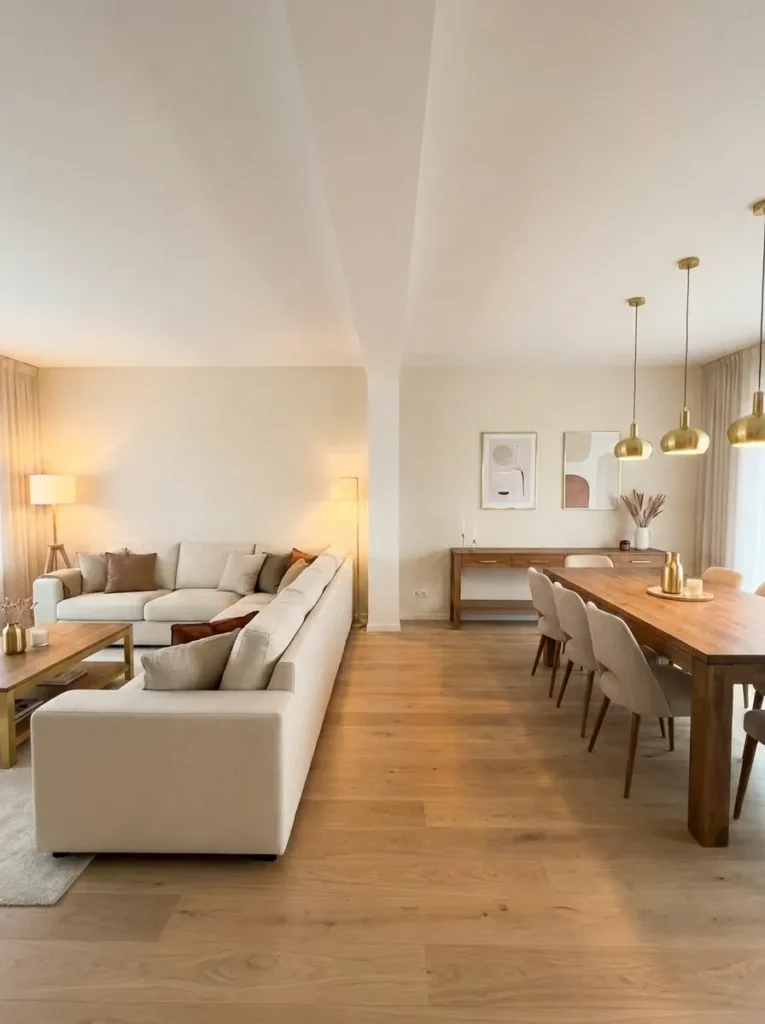
Matching Metallic Finishes
- Repeating one metallic finish across both zones creates a quietly luxurious feel
- Brass, matte black, and brushed nickel are the most versatile finishes for open-plan spaces
- Apply the finish to light fixtures, furniture legs, handles, and small decor pieces
- You don’t need large pieces, as small repeated accents do the connecting work effectively
- Mixing too many metallic finishes is one of the most common open-plan decorating mistakes
Metallic finishes are the small details that hold a well-designed space together. When the same finish, whether brushed brass, matte black, or polished nickel, appears in both your living and dining areas, the eye picks up that repetition and reads the space as intentionally designed. It doesn’t require large furniture pieces or expensive updates. A pendant light, cabinet handles, picture frames, and a coffee table base are more than enough. Small repeated details create a surprisingly strong and cohesive visual connection throughout.
The mistake most people make is mixing too many finishes across an open-plan space. Chrome in one zone, gold in another, black in a third creates visual noise that makes the room feel unplanned.
Choosing one dominant finish and applying it consistently across both areas removes that noise completely. I’ve noticed that even replacing just a few key hardware pieces with a matching finish transforms how polished and put-together the entire combined living and dining layout feels immediately.
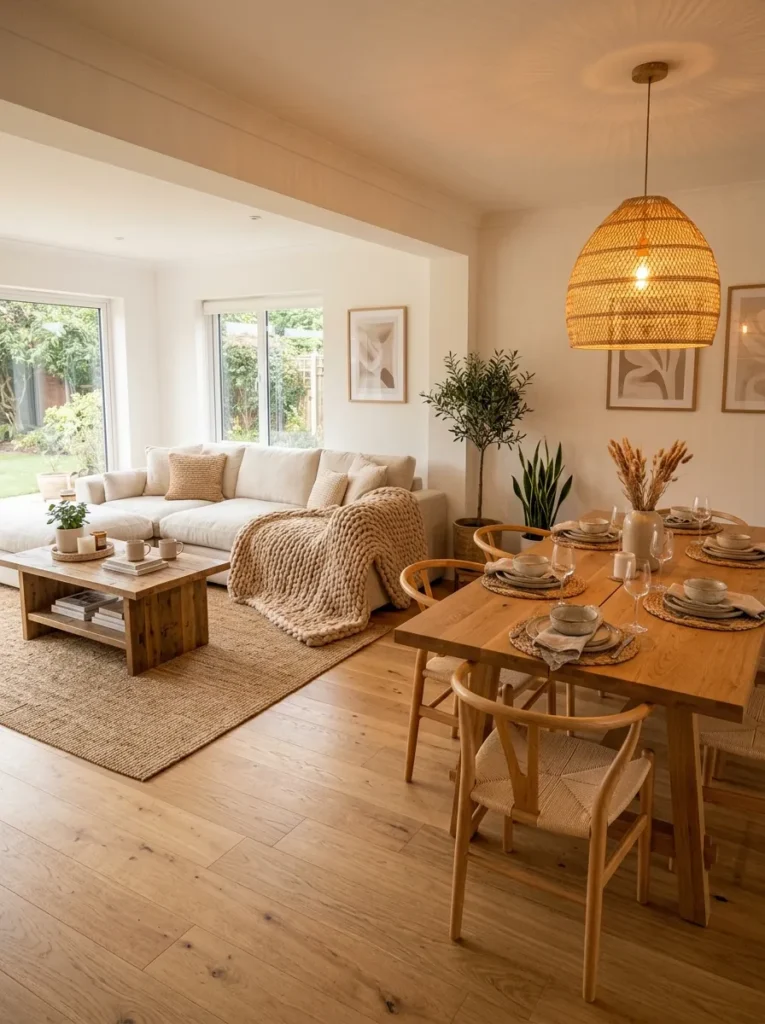
Repeated Decorative Textures
- Repeating natural textures like rattan, linen, and jute across both zones builds warmth
- Texture repetition works even when colors and furniture styles are slightly different
- Small textured accents such as placemats, throws, and baskets are affordable and easy to swap
- Layering textures within the same material family keeps the space feeling rich and cohesive
- This approach works especially well in boho, organic modern, and Scandinavian-style homes
Texture is the design element that makes a space feel lived-in and warm rather than cold and staged. When the same textures appear in both your living and dining areas, including rattan, linen, jute, or chunky knit, the two zones feel like natural extensions of each other. You don’t need to match colors perfectly.
Shared texture creates its own kind of visual harmony that color alone cannot always achieve. It adds depth, warmth, and a sense of comfort that photography simply cannot fully capture.
The best part about using texture as a unifying tool is how affordable and flexible it is. A woven throw on your sofa, rattan placemats on your dining table, and a jute rug underfoot are small decisions that cost very little but deliver enormous visual impact.
Swap them seasonally to refresh the space without redecorating. I’ve noticed that homes with consistent texture repetition across open-plan areas always feel more intentional and inviting than spaces where texture was chosen randomly without any connecting thread.
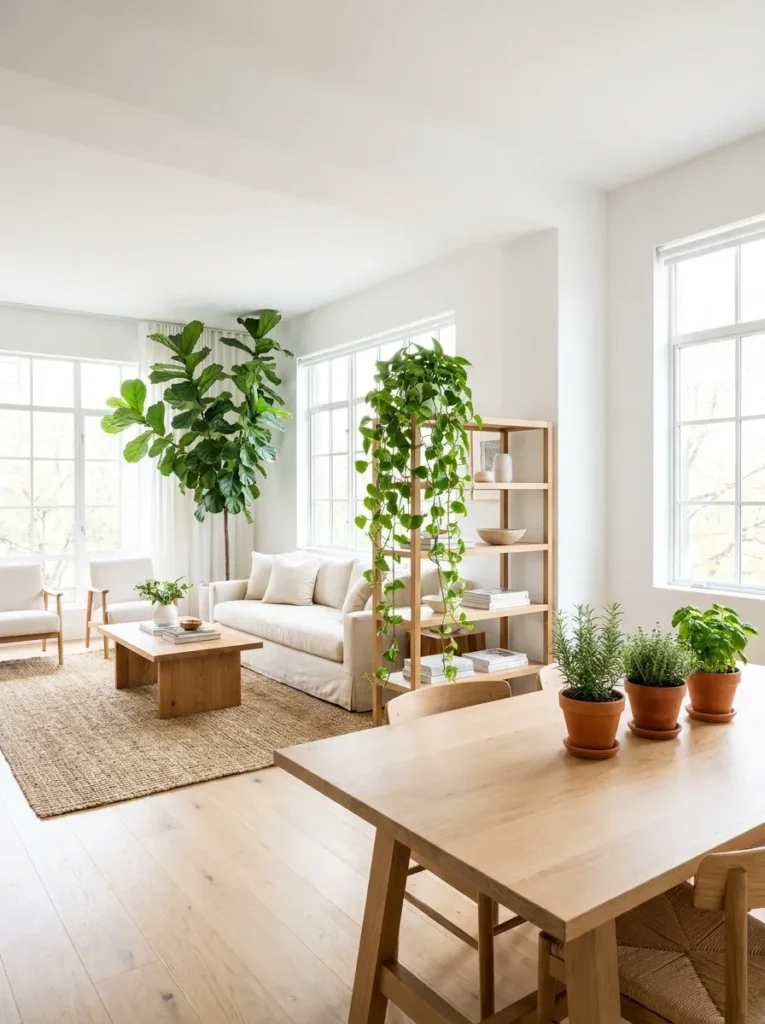
Strategic Plant Placement
- Plants placed in both zones create a natural visual thread running through the space
- Tall floor plants anchor the living area while smaller plants work well on dining surfaces
- Trailing plants on shelves between zones act as a soft, living design bridge
- Greenery adds color, life, and organic texture without cluttering the space visually
- Low-maintenance plants like pothos, snake plants, and fiddle leaf figs work best indoors
Plants do something beautiful in an open-plan layout, as they soften hard edges and create a living thread that runs naturally through the entire space. Placing greenery in both your living and dining areas builds a quiet visual connection that feels organic rather than designed. A tall fiddle leaf fig anchors one corner.
A small potted plant on the dining table echoes it from across the room. That simple repetition of greenery makes both zones feel like parts of one breathing, cohesive space.
You don’t need a greenhouse’s worth of plants to make this work effectively. Three to five well-placed plants across both zones are more than enough. Choose varieties that thrive indoors with minimal care, such as pothos, snake plants, and peace lilies.
Vary the heights and pot sizes to keep things visually interesting. That’s why many designers recommend greenery as one of the first styling layers in any open-plan home. It adds life, freshness, and warmth with very little effort.
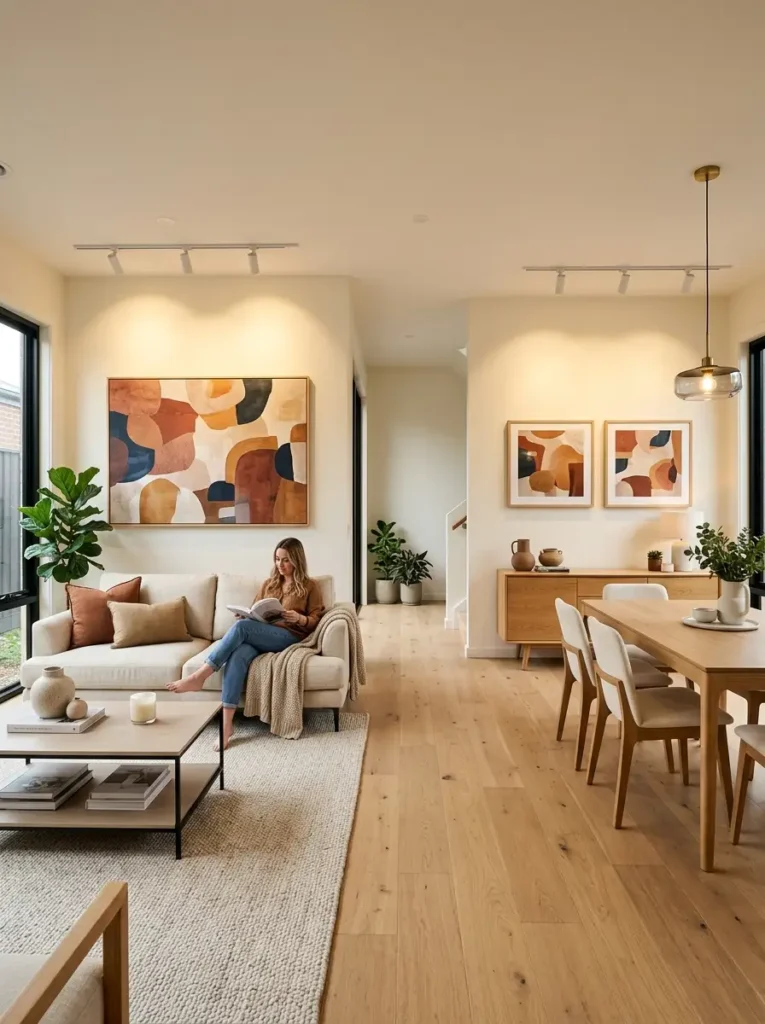
Artwork Visual Connection
- Artwork in the same style or color family visually connects two separate zones
- You don’t need identical pieces, just prints that share a common tone or theme
- Gallery walls work well in living areas while one or two prints anchor dining zones
- Artwork color should reference tones already present in furniture or soft furnishings
- Framing style consistency, such as the same frame finish across all pieces, adds a polished finish
Artwork is one of the most personal and powerful ways to create visual flow across an open-plan space. When prints or canvases in both your living and dining areas share a common color palette or artistic style, the eye moves naturally between the two zones.
The space feels curated rather than random. You don’t need expensive originals to achieve this effect. A set of coordinating prints from the same artist or collection creates the same visual harmony at a fraction of the cost.
Frame finish is the small detail that most people overlook entirely. When every piece of artwork across both zones shares the same frame, whether black, brass, or natural wood, the collection feels intentional and cohesive.
Mix that with artwork that pulls colors already present in your furniture and soft furnishings, and the result is a space that feels richly layered and thoughtfully assembled. I’ve noticed that consistent framing alone, even with mismatched prints, dramatically improves how polished an open-plan layout looks overall.
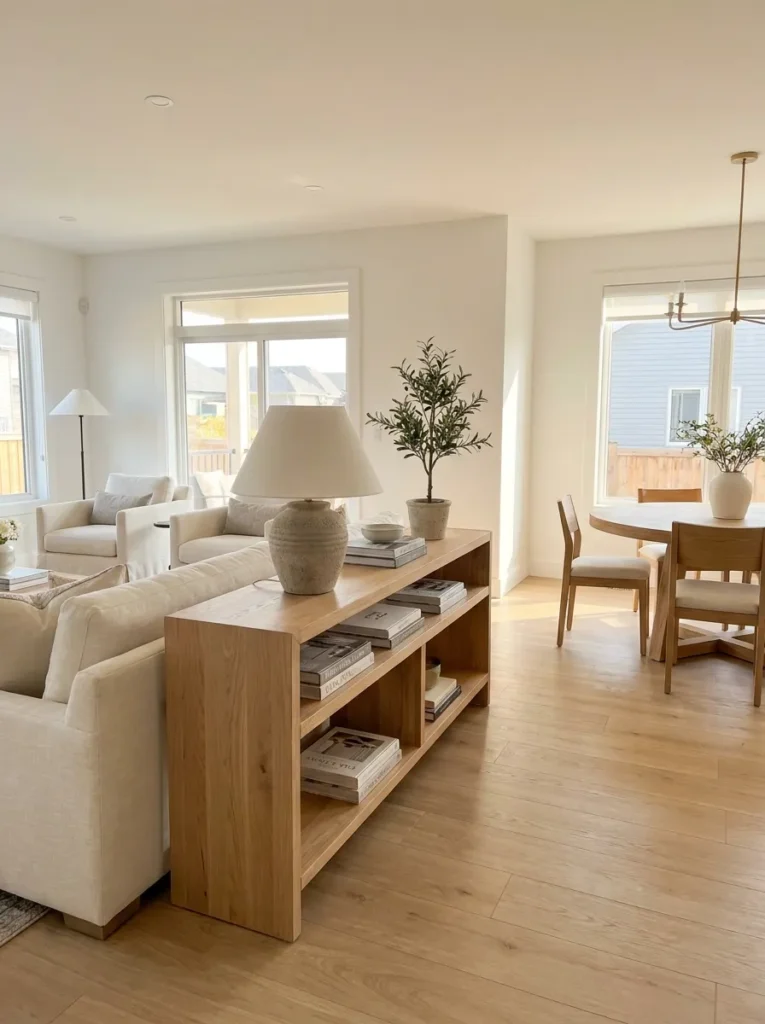
Transitional Furniture Piece
- A console table placed between both zones acts as a natural design bridge
- Style it with items that reference both areas, such as a lamp, plant, and small decorative objects
- It creates a subtle physical boundary without closing off either space visually
- Console tables work well behind sofas, making them functional and visually grounding
- Choose a finish that matches or complements furniture in both the living and dining zones
Sometimes the best way to connect two spaces is to place something deliberately between them. A console table positioned at the boundary of your living and dining areas acts as a quiet transition point, not a wall, not a divider, but a bridge.
It gives the eye a natural place to pause before moving from one zone to the next. Styled thoughtfully with a lamp, a small plant, and a few curated objects, it becomes one of the most functional and beautiful spots in the entire room.
The console table works especially well when placed behind a sofa facing the dining area. It grounds the seating zone from behind while simultaneously introducing a styled surface that faces the dining space.
Choose a finish, whether natural oak, painted white, or walnut, that references materials already present in both areas. That material connection is what allows it to seamlessly connect the living room and dining room without feeling like an afterthought. It’s a small addition that delivers a surprisingly large design impact throughout.
Conclusion:
Your home has the potential to feel beautifully connected, warm, and designed, no matter its size or layout. These eleven ideas show you exactly how small, thoughtful choices create spaces that feel intentional and complete.
You don’t need to do everything at once. Start with one idea that feels right for your space. I’ve seen how simple changes like these completely transform a home’s atmosphere. If these ideas inspired you, save this post on Pinterest, share it with a friend, and start creating the connected living and dining space you’ve always wanted.